We use necessary cookies to make our site work. We'd also like to set analytics cookies that help us make improvements by measuring how you use the site. These will be set only if you accept. For more detailed information about the cookies we use, see our Privacy Notice for more information.
The rise of moonlighting: why 1 in 5 employees secretly work two jobs
1 in 5 UK professionals admit to secretly working two jobs at once, and a standard reference check has no way of catching it. Explore why moonlighting is rising, what's really driving it, and how Verification of Employment close
WRITTEN BY
Tom McAuliffe
PUblished ON
September 7, 2026
Cost of living pressure, competing loyalties, or something more deliberate: whatever the reason, a growing number of employees are quietly holding down two jobs at once. It's sometimes called polygamous working, sometimes moonlighting, and recent research suggests it's far more common than most hiring teams assume.
Traditional referencing, as we've covered before, checks one employer for one period of time. That narrow lens leaves a blind spot big enough to hide an entire second job in, and it's a blind spot a lot of people are using.
What is "polygamous working"?
Polygamous working (also called moonlighting) is when someone holds down two or more full-time jobs at the same time, without telling either employer. It's distinct from an openly agreed side hustle or a declared part-time second role. The defining feature is secrecy: both employers believe they have the applicant's full-time attention, and neither knows about the other.
It's more common than most hiring teams assume. Research published by Cifas in 2025 found that 1 in 5 (19%) UK professionals admit to secretly juggling two competing jobs, and nearly a quarter (24%) think it's "justifiable." ONS figures show the number of UK workers holding multiple jobs has grown too, from 1.2 million between January and March 2020 to 1.35 million between February and April 2025, and that's before accounting for the share who never declare it at all.
Why traditional referencing never catches it
A reference only ever answers one question: did this person work for you between these dates? It has no way of asking the more revealing question: what else were they doing at the same time?
Even a diligent, honest reference check, confirming real dates with a real employer, will pass an applicant working two full-time jobs at once, because each employer can only speak to their own half of the picture. There's no mechanism in the traditional process to compare the two.
Why people do it
Cost of living pressure is the obvious driver, and often the most sympathetic one. But the reasons go further, and some are far more concerning to an employer than a tired employee moonlighting for extra income:
Hiding a conflict of interest. Working two roles at direct competitors gives someone access to both companies' confidential information at once, exactly the scenario Cifas researchers flagged when they titled their findings "moonlighting for a competitor."
Insider threat and data exposure. Simultaneous access to two employers' systems widens the surface for data leakage, whether deliberate or careless.
Corporate espionage. Sometimes a second, undisclosed role isn't about the extra income at all. It's a way to get someone on the inside who can pass intellectual property and trade secrets to a rival. In 2025, Rippling accused an employee inside its own business of searching internal Slack channels for competitor intelligence, sales pipelines, and pricing information dozens of times a day, then passing it straight to leadership at rival HR platform Deel. In a separate case, a former Google engineer was convicted in early 2026 of economic espionage for stealing thousands of pages of confidential AI chip and supercomputer trade secrets while secretly working to found and lead rival AI ventures on the side.
That last example is an extreme case, not the average one. But it illustrates a point worth taking seriously: simultaneous, undisclosed employment isn't just a productivity question. It's a security one.
The business risk
Undisclosed dual employment creates real exposure: breach of exclusivity or non-compete terms, conflicts of interest, intellectual property leakage, time theft, and, in regulated or safety-critical roles, genuine safeguarding risk if someone is stretched across two demanding jobs at once.
Closing the gap: how verification catches what references can't
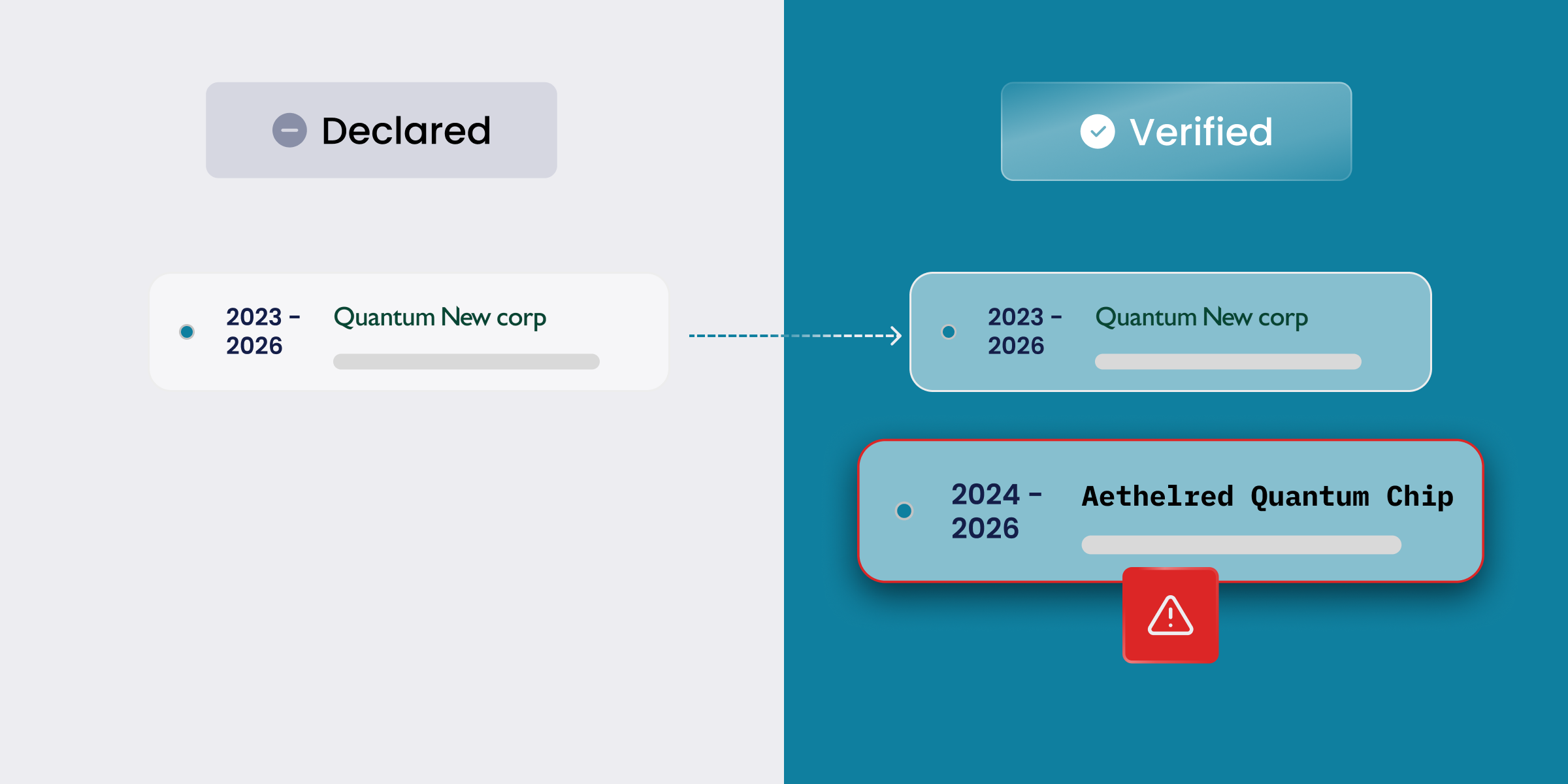
This is exactly the kind of blind spot that source-based employment verification is built to close. Rather than relying on a single nominated referee to confirm one job, Konfir verifies employment directly from the underlying sources: payroll data and HMRC records, with Open Banking as an additional signal of active income continuity – detecting any undeclared PAYE income source, such as moonlighting.
That matters here specifically because it surfaces the full picture automatically. A second active payroll record, or a pattern of earnings arriving from more than one employer during the same period, shows up in the verification itself. Nobody has to think to ask about it, because the data was never limited to what one employer, or one applicant, chose to declare.





.png)
.png)