We use necessary cookies to make our site work. We'd also like to set analytics cookies that help us make improvements by measuring how you use the site. These will be set only if you accept. For more detailed information about the cookies we use, see our Privacy Notice for more information.
How leading screening providers are redesigning employment checks
Leading screening providers are moving beyond reference-led checks. Explore three Konfir-led packages that speed employment screening, lift verification rates, cut admin, and keep applicants in flow.
WRITTEN BY
Tom McAuliffe
PUblished ON
February 9, 2026
The way background screeners and employers verify employment history has fundamentally changed.
Employment checks have always been built around written references. Candidates declared where they worked, and screening and HR teams chased employers; completeness depended on response rates and trust. Today, that model is under strain. Employers want faster hiring (and are increasingly not responding to manual references anyway, where they don’t have to), candidates expect less friction, and screening providers are under pressure to reduce operational cost while also improving fraud detection.
As a result, leading background screening providers are no longer running a single, reference-led workflow. Instead, they are typically embedding Konfir in three proven pre-set employment checking packages depending on the speed, risk, and regulatory requirements of their clients.
What makes these packages possible? Klarity enables Konfir to sit inside the referencing workflow by resolving employer matching upfront, which is a prerequisite for meaningful automation.
Without reliable matching between candidate declared and verified employers, digital verification only provides raw fragmented, and references have to be requested in a separate workflow to digital data. Klarity removes this ambiguity, allowing screening providers to trust verification outcomes and automate the majority of employment checks.
1. Konfir then references: optimising for speed and completeness
For standard employment screening and BPSS-style checks, most employment history checks now start digitally.
In this model, screening begins with Konfir on day one. As soon as a check is initiated, the candidate is invited to Konfir, and their employment history is verified through Konfir’s Verification Waterfall, which combines Open Banking, Payroll, HMRC, and Document Processing data. This immediately confirms up to five years of employment and matches declared to verified activities with standardised employer naming; including gaps, and surfaces undeclared employments that would have never appeared through candidate-declared references alone.
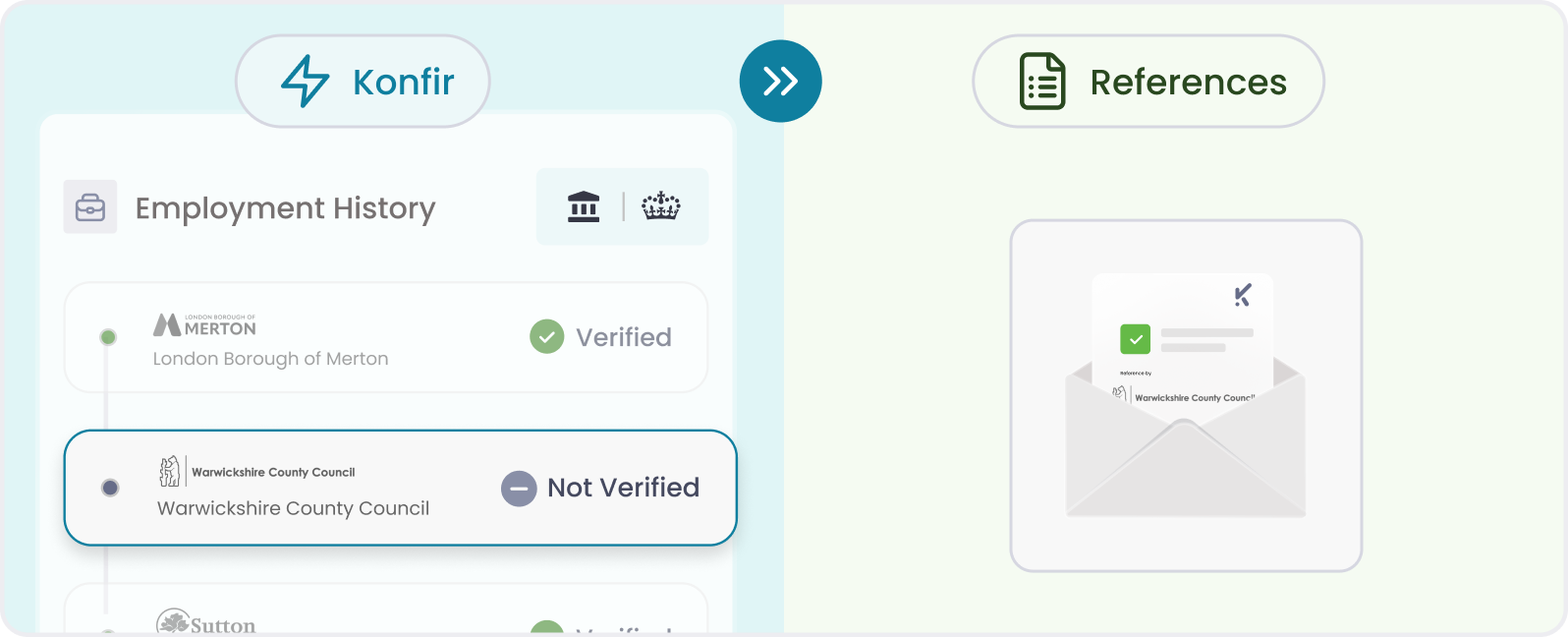
Where Konfir data verifies an employment activity, no reference is required. Instead, references are only initiated where an activity cannot be verified digitally, or where Konfir’s alerts and insights surface new or material risk that may require further assessment.
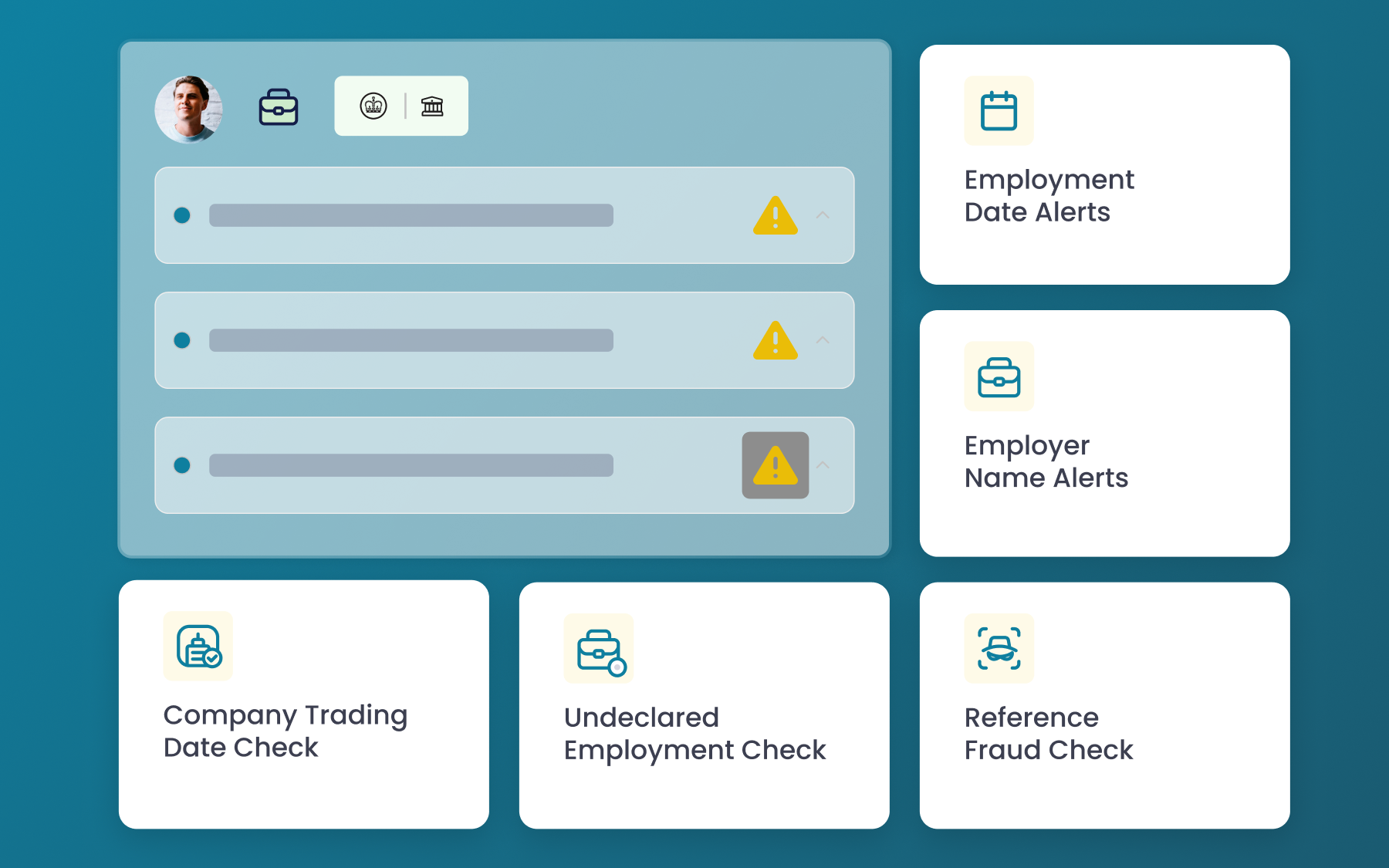
Instead of chasing every employer by default, screening teams use Konfir’s verification results to guide their next steps, if any. Trading date checks highlight employers that are no longer trading or unlikely to respond. Gap verification explains periods of non-employment without escalation. Document processing resolves edge cases that would otherwise trigger manual follow-up. References become a targeted fallback option or escalation tool, not a standard step.
This approach dramatically reduces time to screen and operational efficiency, while also acting as a reputable security and fraud prevention layer in any hiring process.
2. Konfir plus references: pre-screening for fraud prevention or regulated checks
In regulated environments, references may still be mandated. But that does not mean they should be relied on in isolation.
For financial services, healthcare, aviation, and education, screening providers increasingly use Konfir as a pre-screening layer before or alongside references. The goal is not only speed, but risk reduction and operational resilience where referencing fails.
Here, Konfir verifies a candidate’s employment history upfront. Declared roles are confirmed, undeclared employments are surfaced, gaps are identified, and discrepancies are flagged early through alerts and insights. By the time references are requested, screening teams or systems already have a clear picture of where the risk lies.
This has two important benefits -
First, fraud and inconsistencies are surfaced early, not discovered at the end of the process; which is where using legacy processes often result in lengthened turnaround times. References become additive, rather than investigative, which significantly improves their value.
Second, Konfir acts as a pre-gathered fallback when references fail. In regulated screening, references often stall because employers are no longer trading, records are unavailable, or responses never arrive. Konfir’s trading date check makes these operational risks visible upfront, and because Konfir-verified data already exists, screening teams are not left with incomplete checks or rework manually. Document processing and gap verification further reduce dead ends, even in complex cases.
In practice, this model allows screening providers to maintain regulatory assurance while reducing operational friction. References remain part of the process, but they are no longer a major point of failure.
Konfir only: digital-first screening without references
There are also scenarios where references add littlevalue or further return on investment.
For re-screening existing employees, ongoing workforce checks, or quick screening where employment verification is treated as a checkbox exercise, many providers now operate a Konfir-only model.
In these cases, screening is completed entirely through Konfir’s digital verification capabilities. Employment status, gaps, and trading status are verified directly, while alerts and insights provide continuous oversight.
This model delivers extremely fast turnaround times, significantly lower operational costs, and minimal candidate friction. It is particularly effective for detecting secondary employment or moonlighting, where traditional references are often ineffective.
Embedding Konfir successfully
Most screening providers do not choose one model and apply it universally.
Instead, they configure different workflows and advise their clients which to pick based on their sector, regulation, and known hiring policies or preferences.
Providers that get the most out of Konfir embed it early in their process, use alerts and insights to guide decision-making, and position it clearly to employers as a smarter, safer, and more complete way to verify employment, not just a faster one.
Whether the goal is speed, fraud prevention, or regulatory assurance, Konfir works best when it is treated as infrastructure rather than a bolt-on.

.png)

.png)